How long does divorce take, and what does it cost in Canada?

Most people searching "cost of divorce" come to this page with a mix of uncertainty and urgency: "How long does it take to get a divorce in Canada?" , "How much does it cost to get a divorce?", “What’s the average cost of a divorce case” etc.  The good news is that both timeline and cost are largely within your control, and the worst-case scenarios most people fear apply only to a small minority of cases.

Once you understand what drives timelines and costs, the situation becomes manageable. This page is designed to put you in control by explaining how the system works and what choices you actually have. You will note that the process you choose matters more than anything else.

Understanding the two steps in the divorce process: Separation and divorce

Most Canadians use the words “separation” and “divorce” interchangeably, but they refer to two distinct legal stages. Understanding the difference will save you time, money, and a great deal of confusion.

1

Step 1: Separation (where the real work happens)

In Canada, the most common ground for divorce is one year of living "separate and apart." This is ground for divorce set out in the Divorce Act and applies regardless of which province you are in. The one-year clock starts from the date you and your spouse begin living as separated. You can negotiate your separation agreement and do everything else during this period. You do not need to wait until the one-year period ends to start the process.

"Separate and apart" does not necessarily mean living in different homes. Courts recognize separation within the same house where couples maintain genuinely separate lives. That means no shared meals, bedrooms, social activities, or financial interdependence. If you attempt a reconciliation of up to 90 days total, the clock does not reset. Beyond 90 days, it does.

Source: Justice Canada — How to Apply for a Divorce

Separation is the stage where almost everything important gets resolved:

  • Division of property and assets (including the family home, pensions, and investments)
  • Spousal support, if applicable
  • Child support
  • Parenting arrangements

Most couples formalize these decisions in a Separation Agreement, which is a legally binding contract that governs how you and your spouse will move forward. Reaching this agreement is the central challenge of most separations, and how you approach it determines the vast majority of your time and cost.

Most people do not skip straight to a divorce filing. They first spend weeks, months, or sometimes years working through the issues above. The approach you choose to resolve those issues  is the single biggest factor in what your separation costs, whether you choose mediation, collaborative law, or litigation.


2

Step 2: The divorce filing (after 12 months apart)

A divorce is a court order that legally ends your marriage. Under Canadian federal law, a divorce cannot be granted until you and your spouse have lived “separate and apart” for at least 12 months in most cases. This applies in every province. In rare cases, a divorce is permitted before 12 months of separation if the grounds of adultery or cruelty are proven.

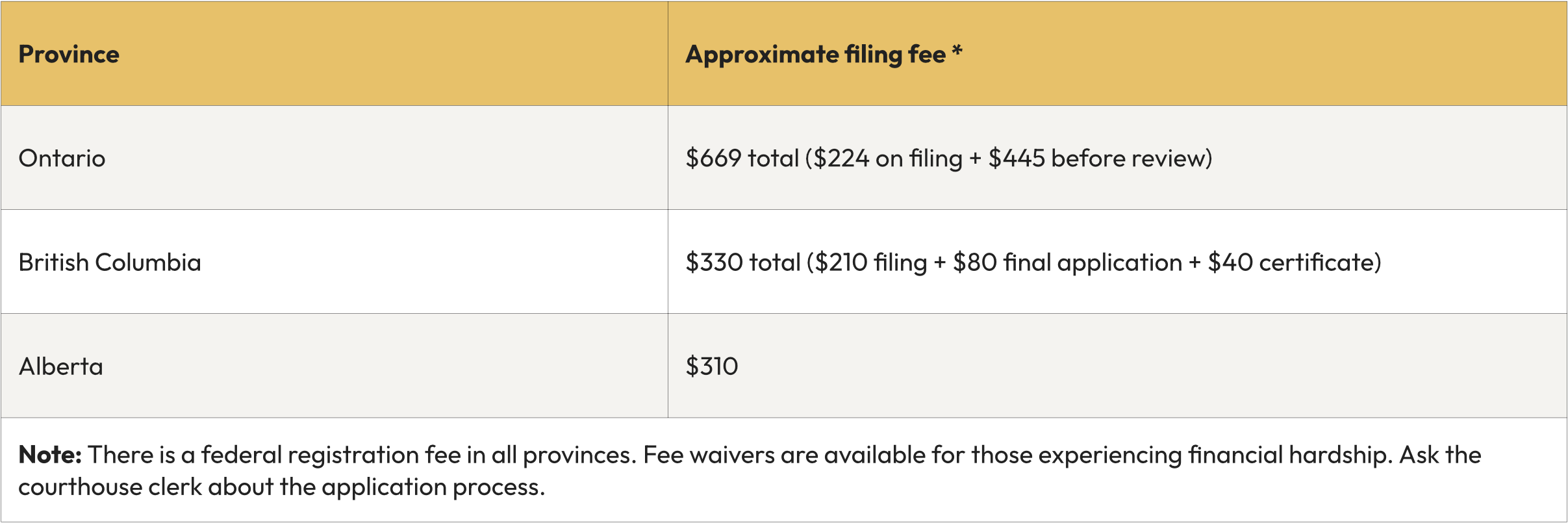
Once the 12-month separation window has passed and all issues have been resolved, the divorce filing itself is a relatively straightforward administrative process. Court fees range from $310 to $669 depending on the province, and the paperwork is processed by a judge — typically without a hearing.

The 12-month clock starts on the date you separated, not the date you reach an agreement. This means the separation period and the resolution process can overlap. Many couples complete their Separation Agreement well before the 12 months are up, and file for divorce as soon as they are eligible.


How long does divorce take? Understanding the full timeline

Because divorce involves two steps, any honest timeline has to account for both. The 12-month separation requirement is a fixed minimum for everyone, but how long resolution takes varies enormously depending on the level of conflict and the process you choose.

Uncontested Divorce: 14–19 Months Total

  • An uncontested divorce is one where both parties agree on all issues involving parenting, support, and property.
  • Mandatory separation period: 12 months
  • Court processing after filing: 2–7 months depending on province and court workload
  • Total from separation to divorce order: 14–19 months

Reaching an agreement  and doing so without prolonged conflict  is what keeps this timeline intact. If disputes arise during the separation period, this timeline grows.

Contested Divorce: 1–3+ Years from Filing

The contested divorce process begins when parties disagree on one or more significant issues. The timeline depends heavily on how many issues are disputed, how cooperative both parties are willing to be, and how backed up the courts are. A moderately contested case that settles before trial typically resolves in 12–18 months from filing. High-conflict cases that proceed to trial can take 2–3 years or more from the date of filing, and that is on top of the one-year separation period.

What drives timelines (and what you can control)

Level of Cooperation

This is the single biggest factor. Cooperative couples can resolve their divorces in a matter of months. They typically negotiate in good faith, share financial information transparently, and focus on workable arrangements rather than trying to “win” or “be right”. High-conflict couples may end up fighting every issue, delay disclosure, and refuse reasonable offers. As a result, those divorces may take years. The level of conflict is not always within your control, but your own response to conflict always is.

Complexity of Property and Finances

A family home, some bank accounts, and shared debts can be divided relatively quickly. Add a business, multiple properties, a pension, stock options, or offshore accounts, and each asset requires expert valuation. That generally means a timeline measured in months rather than weeks. The additional cost of professional appraisals can compound quickly in complex cases: property appraisals run $300–$600 each; business valuations $3,000–$10,000 or more, and pension actuarial valuations $1,000–$3,000. If hidden assets are suspected, then a forensic accountant may be needed. This can add $10,000–$50,000+ to the cost of your divorce. Each expert takes time to engage, produce their report, and sometimes defend their findings.

Parenting Disputes

Agreed parenting arrangements allow a smooth, fast process. A divorce mediator can help resolve parenting disagreements before they become costly. Contested parenting with disputes over primary residence or safety concerns can add significant time and cost. Courts take parenting disputes seriously and move carefully, which can add substantial time to the divorce process. Child specialist assessments or custody evaluations can cost $5,000–$15,000 and take months to complete. Interim hearings on temporary parenting arrangements each take 2–4 months to schedule and attend.

Financial Disclosure

Full, prompt financial disclosure by both parties allows negotiations to proceed. Delayed or incomplete disclosure requires motions to compel, additional examinations, and sometimes expert investigation. All of these add months to the divorce process. Courts also penalize deliberate non-disclosure with cost awards. In documented cases, a spouse who withheld financial information has been ordered to pay the other side's legal fees in addition to their own, among other possible consequences.

Court Backlogs

Court scheduling is outside anyone's control. Urban courts in Toronto, Vancouver, and Calgary have significant backlogs. First case conferences are often 2–4 months out; trial dates can be 12–24 months away once you reach that stage. 

The Advocates’ Society study on civil and family backlogs notes that in Ontario some people may wait “up to five years” before a judge resolves their disputes, due to systemic delays in civil and family courts.

Source: CBC - Canada's backlogged civil and family courts

Choosing an out-of-court process (mediation, collaborative divorce) removes court scheduling from your divorce entirely, and dramatically reduces the time your divorce will take.
What does divorce cost? Two categories of expense

To understand the cost of divorce honestly, it helps to keep the two steps separate. Most of the cost lives in Step 1: resolving your issues. Step 2 (the filing) is relatively inexpensive regardless of how you do it.

Step 1 Costs: Resolving Your Issues

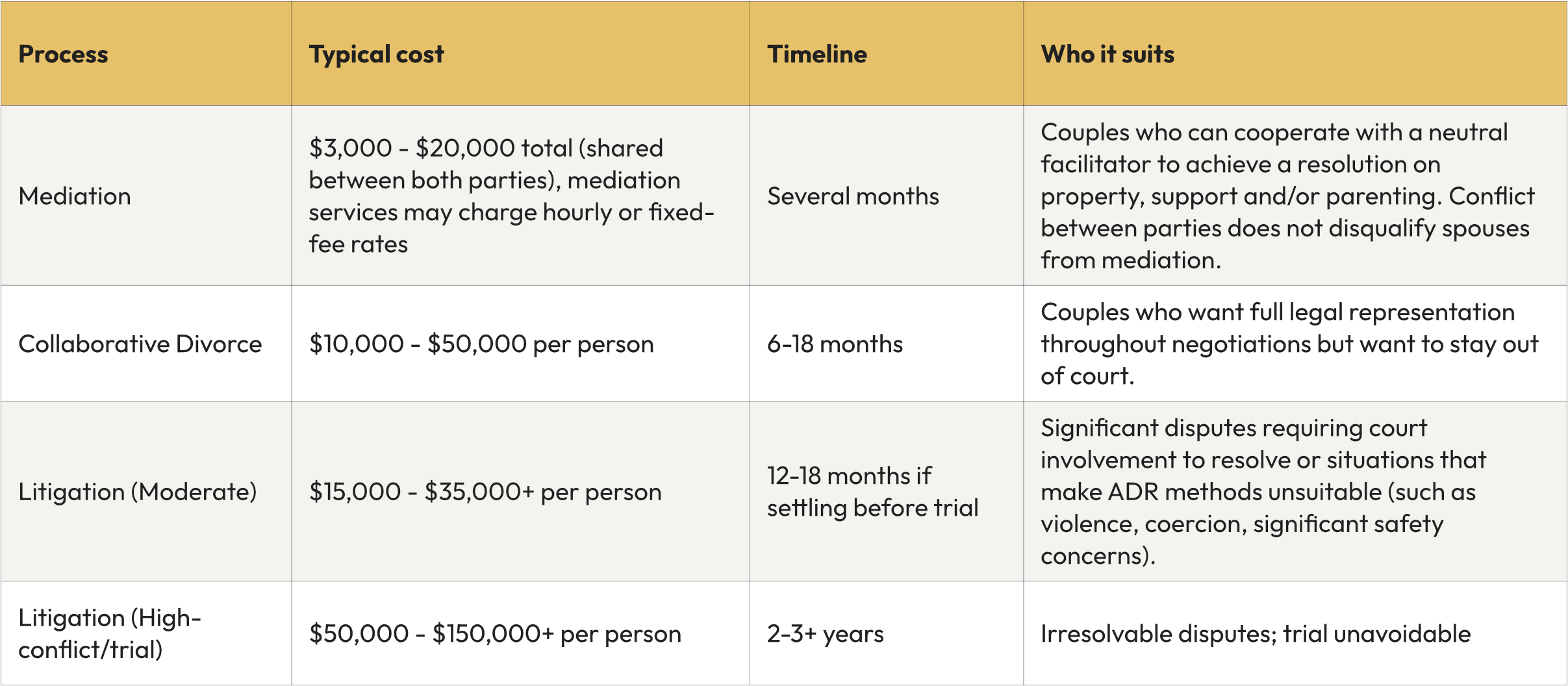
These are the options for reaching a Separation Agreement. Each involves a different level of professional involvement, and is suited to different situations.

When you are considering your options, keep in mind that many provinces may require you to attempt some form of alternative dispute resolution to resolve your issues prior to making a court application. What qualifies to meet this requirement varies from province to province. 

Important: mediation costs are shared between both parties and cover the full resolution process. Litigation costs are per person. A couple who resolves their separation through mediation might spend $3,000–$20,000 combined; the same couple in contested litigation might spend $30,000–$300,000 combined, or more.

Step 2 costs: filing for divorce

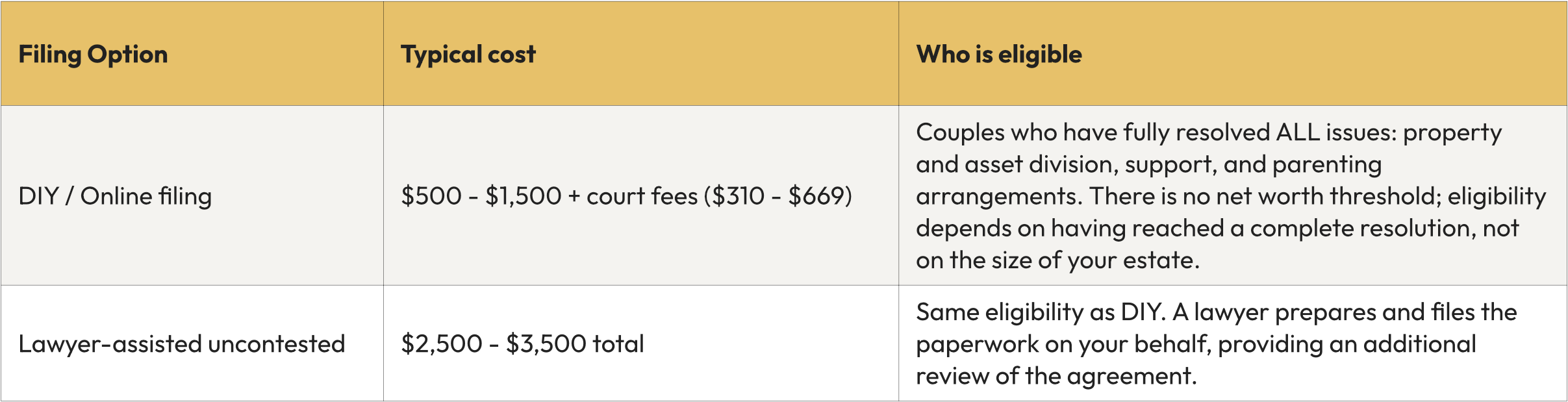
Once all issues are fully resolved,  including property division, all support obligations, and any parenting arrangements, and you have been separated for 12 months, you are ready to file for divorce. These options are for the filing step only. They are not tools for resolving outstanding issues.

For genuinely simple, uncontested divorces, DIY is legally possible and can cost under $1,000 including court fees. Provincial court websites provide the necessary forms free of charge, and BC's Family Law in BC website even publishes a step-by-step guide titled "Do Your Own Uncontested Divorce".

Online services such as Untie the Knot  offer guided document preparation at a lower cost than full lawyer representation. These can reduce form-completion errors and provide filing instructions, but they do not provide legal advice and cannot catch issues you don't know to ask about.

A common misconception: many people assume that because they have few assets, they qualify to file a DIY or online divorce. The deciding factor is not how much you own,  it is whether every issue between you has been completely resolved. If there are any unresolved questions about property, support, or parenting,  no matter how small, you are not yet at the filing stage.

The main risk with DIY: Issues you didn't know to address at the time can become expensive problems later. A pension left out of the agreement or a support clause that doesn't hold up can lead to high-conflict litigation years down the road. Even if you draft the agreement yourself, having a lawyer review it before you sign ($500–$1,500 per person) is a modest investment against that risk.

When DIY is not appropriate: If there is a significant power imbalance between you and your former partner, then navigating divorce without proper legal representation places you at real risk of agreeing to terms that do not reflect your actual legal entitlements. A lawyer is not a luxury in situations such as a history of financial control, coercive behaviour, or emotional abuse.

Court Filing Fees by Province

These fees are paid to the court when the divorce application is filed, regardless of what process you used to resolve your issues:

*There is a federal registration fee in all provinces

Court fee waivers are available for those experiencing financial hardship. Ask the courthouse clerk about the fee waiver application process — ask the courthouse clerk or legal aid office for details.

Sources: Ontario Family Court Fees | Family Law in BC — Court Fees | Alberta Court Fees

What Divorce Lawyer Fees Actually Look Like

Most family lawyers in Canada bill by the hour, so divorce attorney fees depend on how much lawyer time is required. This is typically the biggest variable in total divorce cost. Rates for a Canadian lawyer vary significantly by location and experience:

  • $150–$300/hour in smaller cities and rural areas;
  • $300–$600/hour in most urban centres;
  • $400–$800/hour for senior lawyers in Toronto or Vancouver. 

Lawyers typically require an upfront retainer of $1,500–$3,000 for uncontested matters and $5,000–$15,000 for contested ones. The retainer is held in trust and drawn down as work is completed. Any unused portion is refunded when the divorce process is completed.

Flat fees are available for simple uncontested divorces at many firms. These provide cost certainty and are common for straightforward matters.

You also have the right to request a detailed, itemized invoice and to question any charge that appears excessive or unclear. If you believe fees are unreasonable, every provincial law society has a fee assessment process.

Mediation

Mediation is a structured process in which a neutral, trained mediator helps both spouses work through their issues and reach a mutually acceptable agreement. The mediator facilitates the conversation as an independent third party. The mediator does not give legal advice or arbitrate decisions.

The process typically involves multiple sessions spread over several months. Once sessions are complete, the mediator produces a Mediation Report outlining the terms reached.  The  agreement is then formalized into a binding Separation Agreement and it is recommended that each party receives Independent Legal Advice before signing.

Key advantages of mediation:

  • Cost: Mediation typically costs $3,000–$20,000 total, shared between both parties. Fairway Divorce Solutions works with a fixed fee. Compared to contested litigation, this represents a savings of up to 90% on resolution costs alone.
  • Timeline: Most mediations conclude within months rather than years, and without court scheduling delays.
  • Control: You and your spouse make the decisions, rather than having a judge impose an outcome.
  • Co-parenting: The collaborative nature of mediation tends to preserve a more functional relationship, which matters when children are involved.
  • Third-party expertise: As required, mediation services will often suggest or supplement their process with specialists, including business valuators, financial professionals, real-estate professionals, parenting experts, or external lawyers.

Mediation is appropriate for most separations where both parties are willing to engage in good faith. It does not require that you agree on everything going in. The process will help you resolve your issues. It does require a reasonable willingness to negotiate and voluntarily provide full financial disclosure.

Collaborative divorce: Full legal representation without court

In collaborative divorce, each spouse retains their own collaboratively trained lawyer. Both parties sign a participation agreement committing to settlement only. If the process breaks down, both lawyers must withdraw and the parties start fresh with new lawyers in litigation.

The collaborative team may also include a neutral financial specialist and a child specialist. This comes at a higher cost: $10,000–$50,000 per person, over 6–18 months.

Collaborative divorce is worth considering when the financial or parenting situation is genuinely complex and both parties want professional guidance throughout, but wish to avoid court.

Factors influencing divorce costs: How to keep costs under control

  • Choose a settlement-oriented process. Mediation or collaborative law costs 50–70% less than litigation before trial, and cases almost always settle anyway. Starting in settlement mode is simply doing earlier what most people do eventually, at far less cost.
  • Organize your financial disclosure before your first lawyer meeting. Gathering 3 years of tax returns, 12 months of bank statements, mortgage documents, pension statements (including Canada Life and other group plans), investment accounts, and debt balances before you meet your lawyer can save significant time and cost
  • Communicate efficiently. Use email for routine questions rather than phone calls (lawyer reads and responds to an email in 0.2 hours vs. 0.5 hours for a call). Prepare written questions before every meeting. Stay on legal issues in meetings rather than venting about your spouse: venting to a lawyer at $400-$600/hour costs four times as much as venting to a therapist at $100-$250/hour and accomplishes less.
  • Pick your battles deliberately. A $2,000 piece of furniture that costs $10,000 in legal fees to fight over is not a victory. Identify what genuinely matters to your long-term wellbeing and your children's welfare, and let go of the rest.
  • Respond promptly to requests. Delays from your side generate billable hours on the other side. Quick responses keep the process moving and costs predictable.
  • Consider unbundled legal services. Many family lawyers will review a draft separation agreement, advise on a specific issue, or coach you for a court appearance without taking on full representation. A document review for $500–$1,500 can catch serious problems in a DIY agreement without the cost of full representation.
  • Get legal advice. If you reach an agreement outside of court, have it properly formalized. Verbal agreements and informal arrangements are not enforceable and frequently lead to future disputes.

Low-cost and free legal help in Canada

Legal Aid

Legal Aid is available to low-income Canadians in every province and covers family law matters including separation, divorce, child and spousal support, parenting applications, and separation agreements. Eligibility is means-tested:

  • Ontario (2024): Single person under $23,280; couple under $33,708; family of 4 under $45,289. Apply at legalaid.on.ca or call 1-800-668-8258.
  • Quebec: Single person under ~$29,302 (free tier); higher incomes may qualify with a fixed contribution of $100–$800. Contact Commission des services juridiques.
  • BC: Contact Legal Services Society at lss.bc.ca.
  • Alberta: Contact Legal Aid Alberta at legalaid.ab.ca.

Other Accessible Options

  • Community legal clinics: Free or sliding-scale legal help in many communities; not all handle family law, but many do or can refer. Search "[your city] community legal clinic."
  • JusticeNet: A national network of lawyers and mediators who offer reduced fees on a sliding scale for middle-income Canadians who earn too much for Legal Aid but can't afford regular rates. Registration required; small fee. See justicenet.ca.
  • Court-connected mediation: Available at family courthouses; up to 8 hours at income-based fees; first 2 hours free if a court file has been opened.
  • Duty counsel: Brief free legal advice at courthouses, typically for people who are self-represented and attending a hearing.
  • Law school clinics: Law students supervised by licensed lawyers; free or nominal fee. Check universities with law faculties in your region.

Sources: Legal Aid Ontario — Family Legal Issues | Steps to Justice — Where to Find Legal Help

Common myths about divorce time and cost

Myth: “Hiring the most aggressive lawyer will get it over with faster.”

Reality: The opposite is typically true. Aggressive tactics provoke counter-tactics, harden positions, multiply motions and hearings, and extend timelines by months or years. Courts also notice deliberate escalation and sometimes award costs against the party responsible. Settlement-oriented approaches consistently achieve better results faster at lower total cost.

Myth: “Uncontested divorces are always cheap and quick.”

Reality: An uncontested divorce filing is relatively inexpensive, but reaching an uncontested position requires that all issues have already been resolved. Getting there can take months and significant professional support, depending on the complexity of your situation.

Myth: “DIY divorce is always the best way to save money.”

Reality: DIY filing is inexpensive only if everything is already resolved. Attempting to navigate complex property division, pension splitting, or parenting arrangements without professional support often results in agreements that create expensive legal problems later.

Myth: “If I drag things out, I’ll get a better settlement.”

Reality: Delay tactics generate legal fees on both sides, erode goodwill, and often result in cost awards against the delaying party. Almost all cases settle eventually, the only effect of delaying is paying more to reach roughly the same outcome.

Myth: “Court will make my spouse be reasonable.”

Reality: Courts can impose outcomes, but they cannot make someone cooperative, and the process of getting there is expensive and slow. Judges decide based on the evidence before them, within a legal framework that may not align with what you feel is fair. Many people leave court feeling neither side truly won. Settlement-oriented processes give both parties more control over the outcome.

Myth: “I need to wait until the divorce is final to move on financially.”

Reality: Separation itself starts the legal clock on property division and support. A signed separation agreement can resolve all of your financial and parenting arrangements well before a divorce order is issued. Most people live under their separation agreement before the divorce is officially finalized, and that agreement governs everything during that time.

The emotional reality: What the numbers don't capture

The cost figures above describe legal processes. They don’t capture the emotional toll of prolonged conflict, the impact on children of watching parents fight, or the difficulty of making clear financial decisions while navigating the end of a marriage.

A few things worth noting directly:

  • Fear of running out of money is real. If you are in a financially vulnerable position, the cost of litigation can be genuinely devastating. This is one of the strongest arguments for choosing settlement-oriented processes such as divorce mediation early.
  • Prolonged conflict affects children. Research consistently shows that how parents manage their separation matters more to children’s long-term wellbeing than the separation itself.
  • The "winning" instinct often works against your financial interests. Both parties in a litigated dispute almost always end up with less than they could have negotiated, because so much of the family's resources were transferred to lawyers. The question to ask is not "can I win this?" but "what outcome actually serves my life going forward?"Professional support is available. Counsellors, financial advisors, and mediators can each help you navigate different aspects of the transition. You do not have to manage everything alone, and spending on the right kind of help often reduces total cost.

Understanding your options

Understanding what drives the potential costs of divorce proceedings and how to choose a process that fits your situation is the first step toward moving through divorce efficiently. If you would like to talk through your specific circumstances and understand what path makes sense for you, a free introductory meeting is available.

Canadian resources

Federal:

Provincial courts and forms:

Public legal education (plain language guides):

Legal aid and low-cost help:

Finding a family lawyer:

Frequently asked questions

At Fairway, we understand that facing a divorce is daunting, bringing mixed emotions and many questions. We are committed to ensuring that you have the knowledge and tools to move through the process in a way that protects your assets and your children.

The minimum is approximately 14–19 months: a mandatory 12-month separation period plus 2–7 months for court processing after filing. If there are unresolved disputes, the total timeline can extend to 2–5 years or more.

Begin the separation period as soon as possible, and work to resolve all issues — ideally through mediation — as efficiently as you can. Once the 12-month period has elapsed and a complete Separation Agreement is in place, the filing process is straightforward.

The filing itself costs $2,500–$3,500 with a divorce lawyer, or $500–$1,500 DIY, plus the court fee. The cost of reaching an uncontested position depends on how you resolve your issues: mediation typically costs $3,000–$20,000 total shared between both parties.

Most of the cost of divorce is driven by legal fees during the resolution stage. Lawyer fees are billed hourly, and contested situations require many hours of correspondence, negotiation, motions, and hearings. Choosing a settlement-oriented process (mediation or collaborative divorce) and maintaining open communication with your spouse are the two most effective ways to reduce legal cost.

The eligibility for DIY filing is not based on how much you own — it is based on whether all issues between you have been completely resolved. If property has been divided, support obligations have been settled, and parenting arrangements are in place (where applicable), and you have been separated for 12 months, you may be eligible regardless of asset size. If any of those issues remain outstanding, you are not yet at the filing stage.

No. The majority of Canadian separations are resolved without ever appearing in court. Mediation and collaborative divorce both produce binding agreements without court involvement. The divorce filing itself is an administrative process reviewed by a judge — it does not typically require a hearing.

From the time a matter enters the court system, contested divorces typically take 1–3 years, with high-conflict cases extending to 4–5 years or longer in provinces with significant court backlogs. The mandatory 12-month separation period applies in addition to the contested proceeding timeline.

In mediation, a neutral mediator facilitates negotiation between the parties, who may each consult a lawyer independently. In collaborative divorce, each party has their own lawyer present throughout. Mediation is typically faster and significantly less expensive. Collaborative divorce provides more comprehensive legal support throughout the process, at higher cost..