
Getting your separation agreement

When a relationship ends, one of the first practical questions is: "What do we need on paper?" Many people are unsure whether a legal separation agreement is enough, whether they can write one themselves, and what happens if they sign something they later regret.

These concerns are understandable. Splitting up involves real legal consequences and the decisions made in the first weeks and months can have long-lasting effects. There are also clear rules and protections in place that most people are not aware of until they need them.

This page explains, in plain language: 

  • what a separation agreement is and who it applies to;
  • what it can and cannot cover; 
  • how to create one, with or without a lawyer; 
  • what makes it legally binding;
  • how it fits into the divorce process; 
  • what it costs and how long it takes; 
  • and what the most common misunderstandings are. 

The goal is to help you make informed decisions — not to replace legal advice, which remains important for most situations.

What is a separation agreement?

A separation agreement is a written legal contract between two people who have decided to live apart. It sets out how they will handle the practical realities of living separately. It includes parenting and decision-making for children, child and spousal support, division of property and debts, and other provisions such as insurance, benefits, and dispute resolution.

A few important points about what it is and is not:

  • It applies to both married couples and common-law partners. You do not need to have been legally married to use one. A common law relationship can be governed by the same kind of written document as a marriage, which is sometimes called a domestic contract in certain provinces.
  • It does not end a marriage. Only a divorce order from a court can do that. The written contract governs the practical arrangements; the formal dissolution of the marriage provides the legal termination.
  • It is a contract, not a court order unless a court later incorporates its terms into a divorce order. This distinction matters for enforcement: a contract requires a civil proceeding to enforce; a court order can be enforced through the court's contempt power.
  • It can cover virtually everything except child support and parenting arrangements where children's best interests override the parents' contract.
  • It can not include any term that violates the law or public policy.

Core emotional concerns about separation agreements

Couples that want to separate have similar feelings about separation agreements:

Fear of signing something unfair

Many people worry about agreeing to terms they don't fully understand, or being pressured into an arrangement that favours their former partner. This is a legitimate concern, and it's exactly why full financial disclosure and having your own lawyer review the document are crucial. Financial disclosure is required by law, and in most provinces so is Independent Legal Advice.

Confusion about whether the document is "enough" 

A separation agreement resolves the practical questions about parenting, property and support, but it does not end the marriage. Ending the marriage requires a separate legal process. You can live under separation terms for months before pursuing the divorce, which is entirely normal.

Anxiety about doing it wrong without a mediator or lawyer

DIY contracts are legally possible, but they carry real risks. The concern about "getting it wrong" is well-founded, and this page explains where the risks concentrate and what a minimal investment in legal review can protect against.

Worry about being pressured into signing

A contract signed under pressure, without time to seek legal guidance, or based on incomplete financial information is at significant risk of being set aside by a court. You always have the right to say "I need time to consult a lawyer" before signing anything.

Separation vs. divorce: The key difference

Legal separation is when two spouses decide to live "separate and apart" with the intention of ending the relationship. In Canada, it requires no court process, no paperwork, and no formal declaration. It happens the moment the decision is made. Spouses can be legally separated while still living under the same roof. Courts recognise situations where couples maintain separate lives within the same home due to financial necessity.

The most common ground for divorce in Canada is one year of living "separate and apart." This period can run while the written arrangement is being negotiated: you do not need to wait until the document is signed before the clock starts.

Divorce is the formal legal termination of a marriage by a court order under the federal Divorce Act. It requires an application to the court, satisfaction of at least one ground for divorce (almost always one year of living apart), and a waiting period of 31 days after the divorce order before it becomes final. Once divorced, both parties can legally remarry.

The relationship between the two is often sequential: couples separate, then negotiate and sign a written contract to govern how they live apart. After the one-year period they can then use it as the foundation for an uncontested divorce application. Many people remain in a legal separation indefinitely without pursuing a formal divorce, particularly if neither intends to remarry and the terms of the existing document adequately govern their arrangements.
What a separation agreement can cover

Parenting Arrangements

For couples with children, the parenting plan is typically the most significant and emotionally charged section of any written separation contract. It can include: 

  • who has decision-making responsibility for major decisions about education, health, religion, and extracurricular activities; 
  • the parenting time schedule for regular weeks, weekends, holidays, and school breaks; 
  • how parents will communicate about the children; 
  • travel and vacation protocols; 
  • and the process for handling relocation if one parent wants to move.

Parenting arrangements are always subject to court oversight. A judge can vary the parenting arrangement at any time if it determines a change is in the child's best interests. The document sets the starting framework, but it does not permanently bind a court that later concludes circumstances have changed.

Child Support

Child support must comply with the federal Child Support Guidelines, which establish table amounts based on the paying parent's income and the province of residence. The written contract can address the table amount, how special or extraordinary expenses (daycare, sports, medical, tutoring) are shared, what income disclosure process will apply, and when obligations will be reviewed or recalculated.

Child support cannot be waived. It is the child's right, not the parents' right to bargain away. A court will not uphold a provision to waive or reduce the amount below the Guidelines, and either parent can return to court at any time to have obligations recalculated based on current circumstances.

Spousal Support

The document can address whether spousal support is payable, by whom, in what amount, for how long, and under what conditions it would be reviewed. Spousal support is more flexible than child support: parties can waive it, limit it, or structure it in a number of ways. However, courts retain the authority to override a spousal support waiver if enforcing it would produce an unconscionable result given circumstances that were not anticipated at signing.

Property Division

The terms can set out how the matrimonial home will be dealt with (e.g. if one person keeps it or it is sold), how other real property is divided, how bank accounts and investments are split, how vehicles and personal property are allocated, how pensions and retirement savings are handled, and who is responsible for debts like mortgages, credit cards, student loans, and lines of credit.

Dividing assets, once agreed and signed, is treated as more final than parenting or support terms. Courts are unlikely to re-open a property settlement unless there was serious non-disclosure, fraud, or coercion at the time of signing.

Other Provisions

Separation contracts often include: life insurance requirements (each parent maintains coverage naming children or the other party as beneficiary); income tax arrangements (who claims the children's credits, how RRSP transfers are handled); beneficiary designation changes; and a dispute resolution clause requiring mediation before either party can return to court.

Source: ClickLaw Wiki (BC) — Agreements After Separation

What makes a separation agreement legally binding

A separation agreement is a legal contract. For it to be enforceable, it must meet the following requirements:

  • In writing. Verbal arrangements and informal emails are not enforceable under Canadian family law statutes. The document must be a formal written instrument.
  • Signed by both parties. Both spouses or partners must sign.
  • Witnessed. Most provinces require the signatures to be witnessed. A lawyer or notary can confirm the specific requirement in your province.
  • Full and honest financial disclosure. Both parties must have disclosed all assets, debts, income, and financial interests before signing. Concealed or misrepresented assets are one of the most common grounds for a court to set a signed contract aside.
  • Voluntary consent. The document must have been signed freely, without duress or coercion. A contract signed under threat, or under extreme time pressure without opportunity to seek counsel, is vulnerable to challenge.
  • Terms not grossly unfair or contrary to law. Courts will set aside provisions that are unconscionably one-sided, that attempt to waive child support, or that violate public policy.

Independent Legal Advice (ILA)

A lawyer review is not strictly required in every province, but it meaningfully strengthens the enforceability picture. When each party consults their own separate lawyer before signing, then both parties will have understood the document's contents and implications and the rights they were modifying or giving up. The cost of a lawyer review ($500–$2,000 per person) is modest compared to the cost of litigation if the contract is later challenged.

When Courts Set Agreements Aside

Courts can and do vary or set aside separation agreements in a number of circumstances such as:

  • non-disclosure or deliberate concealment of assets; 
  • clear duress at the time of signing; 
  • terms so one-sided they are unconscionable; 
  • lack of understanding of the document's meaning; 
  • and, for parenting and child support terms, a material change in circumstances that makes the original arrangement no longer in the child's best interests.

If there is a significant power imbalance between you and your former partner, e.g. due to financial control or emotional abuse, then  your own lawyer's review is especially important. An arrangement negotiated in the shadow of fear may not reflect what you would have agreed to freely. Courts can look at these circumstances when assessing enforceability.

Source: Separation Agreement Ontario — What Makes an Agreement Enforceable?


Creating a separation agreement: Your options

Lawyer-Drafted Contract

Each party retains their own family lawyer. Lawyers gather financial information, advise their respective clients on legal rights and entitlements, negotiate on their clients' behalf, and draft a comprehensive document. This is the most expensive approach and passes some of the decision-making process to the legal process. In some cases it’s the only feasible approach, in particularly in situations where a there is a  history of power imbalance and abuse.

Mediation-Assisted Agreement

A neutral family mediator helps both parties discuss and resolve issues and reach a mutually acceptable arrangement. After mediaition is complete, a formal separation agreement is drafted and it is strongly suggests that  bBoth parties can then obtain independent legal advice before signing. Mediation is generally less expensive than full lawyer-driven negotiation, preserves more control over the outcome, and tends to produce arrangements both parties feel invested in following. It is not appropriate where there is serious domestic violence or coercive control without specialised safeguards and screening.

DIY or Template Agreements

Self-drafted contracts using online templates are legally possible and lower the cost of a divorce. They may be workable in genuinely simple situations where there is a short relationship with no children, minimal assets, similar incomes, and complete agreement on all issues.

The risks are real, however. Common problems include: 

  • missing key issues (pensions, income tax implications, future changes); 
  • vague or ambiguous wording that is difficult to enforce;
  • failure to meet legal witnessing or disclosure requirements; 
  • one-sided terms resulting from one party not understanding their legal rights;
  • and a much higher likelihood of being successfully challenged later. 

At a minimum, both parties should have a lawyer review any self-drafted document before signing.

Why Independent Legal Advice Remains Important

A focused legal review costs approximately $500–$2,000 per person. It catches missing issues, clarifies the legal effect of specific provisions, confirms that disclosure is complete, and strengthens enforceability significantly. Compared to the cost of litigation if the contract is later challenged ($10,000–$50,000+), this is a modest investment in certainty.

Source: McKenzie Lake — The Hidden Risks of DIY Separation Agreements 

How a separation agreement connects to filing for divorce

Using the agreement to support an uncontested divorce

A signed, comprehensive separation agreement dramatically simplifies the divorce process. It shows the court that parenting arrangements and child support are in place, that property division and spousal support have been addressed, and that both parties have resolved their issues. This makes an uncontested or joint divorce application possible.

An uncontested divorce involves no court appearance. A judge reviews the court documents and, if satisfied, issues the divorce order. This is the most common form of divorce proceedings in Canada, and a well-drafted written contract is what makes it achievable.

Typical sequence from separation to final divorce

  1. The separation begins. The one-year clock starts running from the date you and your spouse begin living "separate and apart." You can begin negotiating immediately.
  2. Negotiate and sign the written contract. This can take weeks for cooperative, simple situations or several months for more complex ones. Both parties should obtain a legal review before signing, in some provinces that is a legal requirement.
  3. Live under the terms while apart. The document governs parenting time, support payments, and other provisions during the separation year and beyond.
  4. After one full year, confirm eligibility for divorce. At least one spouse must have been a resident of the province where you file for the required period.
  5. Prepare the divorce application. Typically a joint application. Required court documents generally include: the original marriage certificate, the divorce application form, an affidavit, and a copy of the signed document.
  6. File at the family court and pay filing fees. Court fees range from approximately $31260 to $669 depending on the province.
  7. Court review. A judge reviews the application, confirms the separation requirement is met, and assesses whether child-related arrangements are reasonable. No court appearance is typically required for uncontested divorce proceedings.
  8. Divorce order issued, then final after 31 days. The order becomes absolute after 31 days, at which point both parties may legally remarry.

Source: Justice Canada — Applying for a Divorce

Changing the terms later

Parenting and Support: More Changeable

Parenting arrangements and support obligations can be varied when there has been a "material change in circumstances", meaning a change that is substantial and was not reasonably foreseeable at signing. Common examples include: a significant income change, a child's needs changing, relocation making the existing schedule unworkable, or safety concerns emerging. Either party can apply to a court for a variation. Alternatively, both parties can sign an amending document at any time by mutual consent.

Dividing Assets: More Final

Property division is generally treated as final once signed. Courts are reluctant to re-open a settled property arrangement. The limited exceptions are: serious non-disclosure or fraud about assets at signing; coercion or duress that impaired genuine consent; and, in some circumstances, terms so unconscionable that enforcing them would produce an unjust result.

If you have concerns about whether all assets have been fully disclosed, then raise them before signing a property settlement, not after.

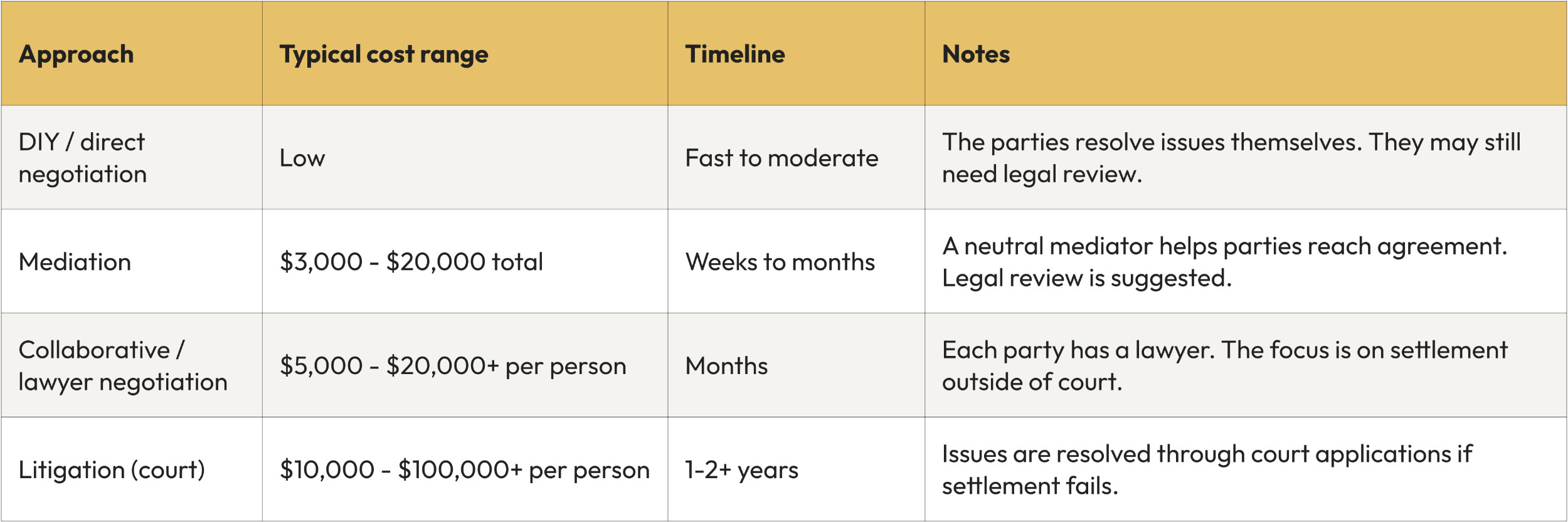
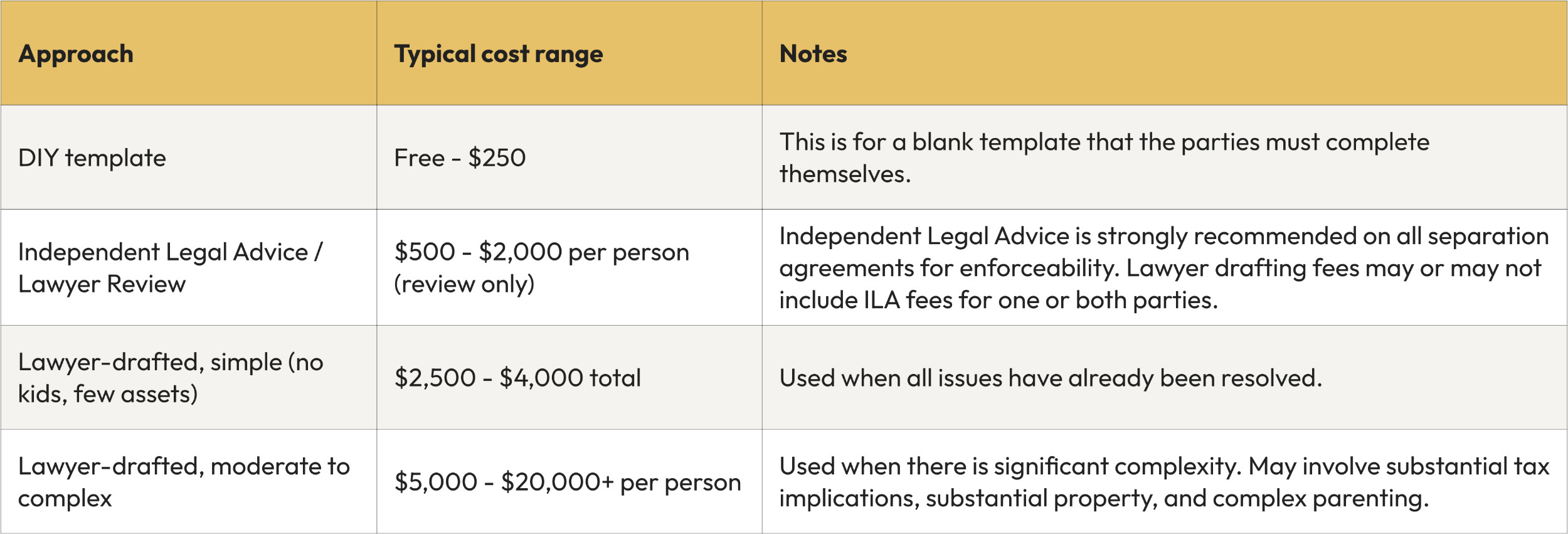
Costs and Timelines

1. How you reach an agreement (the process)

A table comparing the different options for reaching a separation agreement including costs, timelines, and notes.

2. How the agreement gets drafted

A table comparing the drafting options for separation agreements, including approaches, costs, and notes.

Hourly rates for family lawyers typically range from $250–$600 in major urban centres, and $150–$400 in smaller cities.

Source: Khan LLP — How Much Does a Separation Agreement Cost in Ontario?

Issues checklist

This is a thinking tool, not a legal template. Use it to ensure no major issue is overlooked before meeting with a lawyer or mediator.

Parenting (if there are children)

  • Who makes major decisions?
  • Primary residence and schedule
  • Holiday and school break schedule
  • Communication between parents
  • Relocation rules
  • Travel permissions

Child Support (if there are children)

  • Monthly table amount under Guidelines
  • Section 7 / special expenses
  • Payment method and timing
  • Annual income disclosure and review schedule
  • When obligations end

Spousal Support

  • Is it payable? By whom?
  • Amount and duration
  • Lump sum or monthly?
  • Review or variation conditions
  • What ends or changes it

Property and Debts

  • Matrimonial home: keep, sell, or buyout
  • Other real property
  • Bank accounts, investments, RRSPs, TFSAs
  • Pensions (often overlooked)
  • Vehicles, household contents
  • Mortgage, credit cards, loans, lines of credit
  • Business interests (if applicable)

Other Provisions

  • Life insurance requirements
  • Income tax matters
  • Extended health and dental
  • Dispute resolution process
  • Review schedule

Process Safeguards

  • Full financial disclosure by both parties
  • Independent legal advice for each person
  • Signed by both parties, properly witnessed
  • No time pressure or undue urgency
  • Both parties retain a copy

Common myths

Here are some common myths we hear from divorcing couples

Myth: "We're separated, so we automatically have a written contract." 

Reality: Living apart is a fact. A written legal contract is a separate document you must consciously negotiate and sign. One does not follow automatically from the other.

Myth: "If I sign something, it can never be changed." 

Reality: Parenting and support terms can be varied by mutual consent or court order when there has been a material change in circumstances. Property terms are more final, but can be reopened in cases of fraud or serious non-disclosure.

Myth: "If we agree informally, that's as good as a signed document." 

Reality: Verbal arrangements and informal emails are very difficult to enforce under Canadian family law. Provincial statutes generally require a written, signed, and witnessed instrument to be binding. A handshake gives you almost no legal protection if the other party later changes course.

Myth: "We can divide property and decide child support however we want." 

Reality: Property division offers wide latitude, but courts can overturn unconscionable or fraudulently-based settlements. Child support must meet or exceed the Guidelines — it cannot be waived. Parenting is always subject to the child's best interests, which a court can reassess at any time.

Myth: "I don't need to disclose everything — they trust me." 

Reality: Full financial disclosure is a legal requirement. Concealing or understating assets is one of the most reliable grounds for a court to set a signed contract aside, regardless of how much time has passed.

Myth: "A separation agreement is the same as a divorce." 

Reality: A written separation contract governs how you live apart. A divorce is a court order legally ending the marriage. You remain legally married until a divorce order is granted, even if the contract resolves every practical issue between you.

Your next steps

If you are considering a separation agreement and would like to understand how it fits your specific situation — including how process choices such as mediation compare to lawyer-assisted negotiation — a free introductory meeting is available.

Frequently asked questions

At Fairway, we understand that facing a divorce is daunting, bringing mixed emotions and many questions. We are committed to ensuring that you have the knowledge and tools to move through the process in a way that protects your assets and your children.

A written legal contract between spouses or common-law partners setting out parenting arrangements, child and spousal support, property division, and debts when they split. It is legally binding when properly signed, but does not end the marriage — only a divorce order does that.

Not legally required, but strongly recommended. If you have children, the court will want to see that parenting and child support are addressed before granting a divorce. A comprehensive written contract makes the divorce application faster, simpler, and less expensive for both parties.

Yes, when properly executed: in writing, signed by both parties with a witness, supported by full financial disclosure, and entered into voluntarily. Courts can set the contract aside for non-disclosure, duress, unconscionable terms, or lack of understanding without legal counsel.

You can, but it carries real risk: missing key issues, vague wording, unmet legal requirements, and a much higher chance of being challenged later. At minimum, both parties should have a lawyer review any self-drafted instrument before signing. The cost of review is modest compared to the cost of a later dispute.

Default family law applies, determined by province. Married spouses divide property under provincial equalization or division rules; spousal support is determined by guidelines and litigation; parenting requires a court order or ongoing negotiation. Without a written document, verbal arrangements are difficult to enforce and conflict is more likely.

Yes. Parenting and support terms can be varied by mutual amending document at any time, or by court order on proof of a material change in circumstances. Property division is generally more final and harder to reopen, except in cases of serious non-disclosure, fraud, or coercion at signing.

It shows the court that parenting, support, and property issues are resolved — the foundation for an uncontested application with no court appearance required. The document is attached to the divorce application; the court reviews it and, if satisfied, issues the divorce order.

Legal separation is living apart with the intention to end the relationship — no court process needed, does not end the marriage. Divorce is a court order legally terminating the marriage, requiring an application and satisfaction of the one-year ground. Both parties can remarry only after the divorce order is final.

Canadian resources

Federal:

Provincial government information:

Public legal education (plain language guides):

Legal aid and low-cost options:

  • Legal Aid Ontario: 1-800-668-8258 or legalaid.on.ca
  • Legal Aid BC: lss.bc.ca
  • Legal Aid Alberta: legalaid.ab.ca
  • Community legal clinics: search "[your city] community legal clinic"
  • Unbundled legal services: ask any family lawyer if they offer document review or advice-only services at a reduced cost

Finding a family lawyer: